

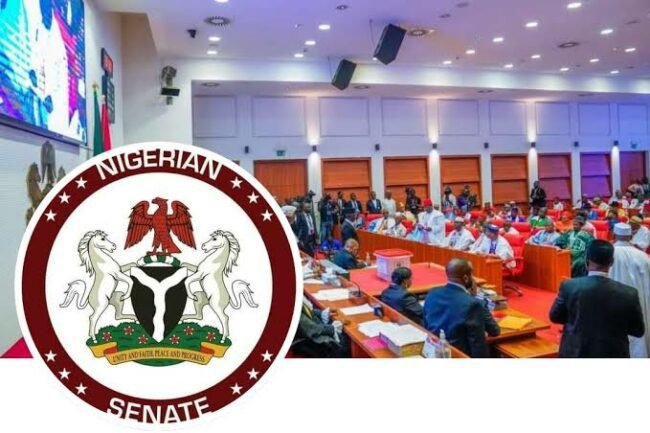
The Nigerian Senate has amended its standing rules to restrict eligibility for presiding and principal offices to lawmakers who have served at least two consecutive terms.
The amendment was adopted on Tuesday through a voice vote presided over by Senate President Godswill Akpabio.
Under the revised rules, only senators with a minimum of eight years of continuous service can contest for the positions of senate president and deputy senate president.
The decision follows speculation that former senators, including Hope Uzodimma, Ifeanyi Okowa, and Ovie Omo-Agege, may be planning a return to the red chamber and possible bids for the senate presidency in 2027.
The amendment came after a closed-door session that lasted about three hours.
Further changes were made to Orders 4 and 5 to tighten eligibility for leadership positions in the 11th National Assembly.
Order 4 now mandates that nomination for presiding offices must strictly follow ranking. This includes former senate presidents, deputy senate presidents, principal officers, senators with at least one term, former members of the House of Representatives, and first-time senators where necessary.
Order 5 introduces an additional condition, stating that no senator can contest for any principal office unless they have served at least two consecutive terms immediately before nomination.
The changes effectively exclude incoming senators who were not part of the 9th and 10th assemblies from contesting leadership positions.
Presiding offices in the senate include senate president and deputy senate president, while principal offices cover positions such as senate leader, deputy senate leader, chief whip, deputy chief whip, minority leader, deputy minority leader, minority whip and deputy minority whip.
Senator Adams Oshiomhole was the only dissenting voice during the adoption of the amendment. His attempt to raise a point of order was overruled by the senate president.
“This was not what we agreed at the closed-door session,” Oshiomhole said during plenary.
Before the amendment, any ranking senator—defined as one who had served at least four years—was eligible to contest for presiding offices.
The senate also introduced additional procedural changes.
Order 8(1) now fixes committee meetings between 3pm and 6pm from Monday to Friday, except on the second and fourth Fridays of each month.
Order 8(2) provides that plenary sessions will hold on Tuesdays, Wednesdays and Thursdays from 11am to 3pm, unless extended by the senate leader.
Section 55(11) was amended to allow presiding officers and nominees undergoing screening to drink water during plenary.
Section 66(8) now requires suspended senators to withdraw from plenary as directed by the senate president, with the duration of suspension determined by resolution.
Section 94(1) provides that committees shall have between seven and 25 members, while no senator may serve on more than seven committees. Membership must also reflect the six geopolitical zones.
Section 96 was revised to include oversight of regional development commissions across the six geopolitical zones.
The senate also created a new committee on reparation and repatriation.
Following the amendments, Akpabio directed the Clerk of the Senate, Emmanuel Odo, to update the standing rules accordingly.