



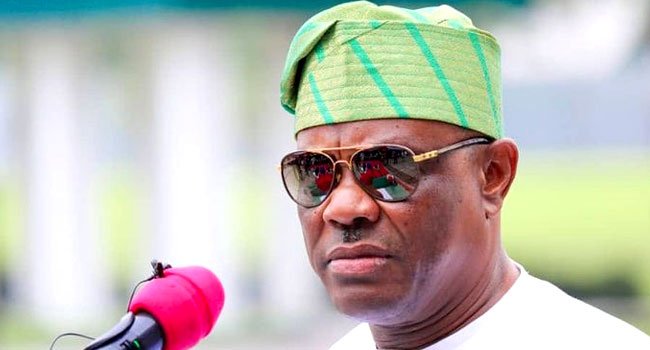
In a pointed critique, Nyesom Wike, the Minister of the Federal Capital Territory, has accused former Transportation Minister Rotimi Amaechi and other opposition leaders of hypocrisy regarding their stance on the electronic transmission of election results under the newly signed Electoral Act. During a media chat, Wike highlighted the recent outcry from the opposition against a provision that permits manual result transmission when electronic systems fail, questioning the sudden change of heart from those who previously opposed the electronic option.
Wike recalled that, while in government, Amaechi and his allies had allegedly dissuaded former President Muhammadu Buhari from endorsing electronic transmission, fearing it could jeopardize their electoral success. “Amaechi and others said, ‘If you sign, you will lose the election,’” Wike pointed out, emphasizing the irony of Amaechi’s current demands for electronic transmission.
Clarifying the new Electoral Act’s provisions, Wike asserted that the law does not eliminate electronic transmission. Instead, it includes safeguards to prevent voter disenfranchisement by allowing manual transmission should electronic systems fail—an acknowledgment of Nigeria’s challenging network infrastructure. “We are not saying there shouldn’t be electronic transmission, just that we should ensure people’s votes are counted, even if there are problems with the technology,” he explained.
The former governor also addressed the contentious topic of political party primaries, criticizing the traditional indirect primaries that enable wealthy elites, such as governors and ministers, to dominate party structures. He praised the new law’s introduction of direct primaries, arguing it would foster a fairer political landscape and challenge the status quo of power concentration.
Wike also remarked on the tendency of Nigerians to voice dissatisfaction while simultaneously exhibiting selective outrage over electoral processes. He termed them “professional complainants,” suggesting that their complaints about the former system were valid but failed to translate into effective advocacy for change.
The opposition parties, including the African Democratic Congress (ADC) and the New Nigerian Peoples Party (NNPP), have recently rallied for amendments to the Electoral Act 2026.