


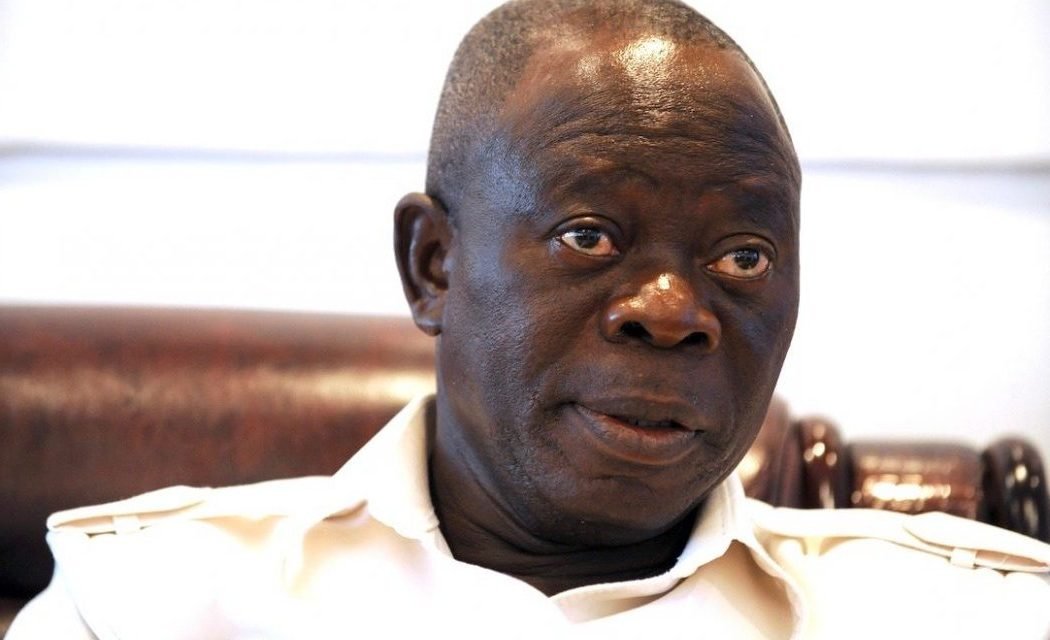
Senator Adams Oshiomhole has called on Senate President Godswill Akpabio to resign amid controversy surrounding proposed amendments to the Senate Standing Orders regulating the emergence of presiding and principal officers in the upper chamber.
Speaking with journalists in Abuja, Oshiomhole criticised the proposed amendment, describing it as morally flawed and procedurally questionable.
According to the former Edo State governor, the revised rules would require senators seeking principal offices to have completed eight consecutive years in the Senate, a condition he argued Akpabio himself does not meet.
Oshiomhole said the Senate President became minority leader during his first term and is now presiding over attempts to alter the rules in a way that could disqualify other lawmakers despite his own record.
He argued that if the Senate eventually adopts a rule requiring eight consecutive years before a senator can become Senate President, Akpabio should “lead by example” by vacating the position because he allegedly does not possess the qualifications under the proposed framework.
The controversy followed attempts by the Senate to amend its Standing Orders concerning eligibility for principal offices.
However, the Senate later reversed the amendment after a motion sponsored by Senate Leader Opeyemi Bamidele and adopted under the supervision of Deputy Senate President Jibrin Barau.
Under the previous rules, only senators who had served two terms, including the immediate preceding term, were eligible to contest for principal offices in the Senate.
UN Committee Raises Alarm Over Treatment of Indigenous Children in Australia’s Justice System
The United Nations Committee on the Elimination of Racial Discrimination has expressed concern over what it described as systemic racial discrimination against Aboriginal and Torres Strait Islander children within Australia’s youth justice system.
In a statement released on Tuesday, the committee said Indigenous children continue to face widespread discrimination in the administration of criminal justice and called on Australian authorities to intensify efforts to address the problem.
According to the committee, Aboriginal and Torres Strait Islander children accounted for about 65 per cent of children in detention during the 2023–2024 period despite representing only 6.5 per cent of Australia’s child population aged between 10 and 17 years.
The committee stated that the disparity reflected broader structural inequalities affecting Indigenous communities, including limited access to education, healthcare, housing and social welfare services.
It also raised concerns about racial profiling, over-policing and law enforcement practices that allegedly increase the likelihood of Indigenous children being arrested, prosecuted and detained.
The UN body criticised the minimum age of criminal responsibility in several Australian jurisdictions, noting that some states still permit children as young as 10 years old to face criminal prosecution, contrary to international human rights standards.
CERD further warned about detention conditions affecting Indigenous minors, citing allegations of prolonged solitary confinement, detention alongside adults, inadequate healthcare, ill-treatment, the use of spit hoods and incidents involving self-harm and suicide.
While acknowledging measures introduced by the Australian government, including the establishment of the National Commission for Aboriginal and Torres Strait Islander Children and Young People and the National Justice Reinvestment Program, the committee said there was insufficient evidence showing that the initiatives had effectively reduced Indigenous over-representation in detention centres.
The statement adds to growing international scrutiny of Australia’s youth justice system.
In 2025, UN Special Rapporteur Alice Jill Edwards and Special Rapporteur Albert K. Barume criticised proposed legislation in Queensland that would expand the range of offences for which children could receive adult sentences.
The experts warned that the proposed reforms would disproportionately affect Indigenous children already heavily represented in the criminal justice system.