

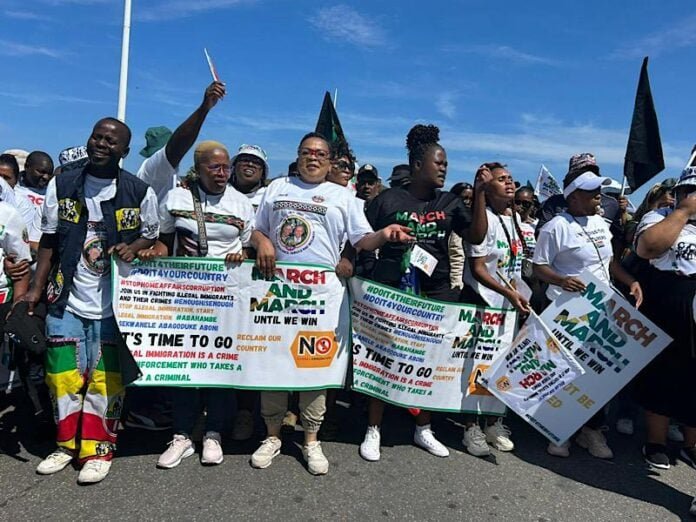
Tension is rising in South Africa’s Eastern Cape after a controversial coronation involving members of the Igbo community sparked protests and strong reactions from local groups. The demonstration was led by members of ActionSA, alongside traditional leaders and residents, who described the coronation as an insult to the province’s sovereignty and traditional authority system. The event reportedly took place in East London, where protesters insisted that South Africa’s constitution does not provide for a foreign national to be installed as a king within the country.
During the protest, participants demanded the immediate deportation of Nigerians linked to the coronation, with some warning that failure by authorities to act could lead to unrest. One protester said the move appeared to suggest an attempt to create a parallel authority structure, referencing South Africa’s history of apartheid-era “homelands” and arguing that such developments should not be allowed to resurface in any form. Traditional leaders also joined the calls, saying the incident undermined established kingships in the region, including that of King Vululu Andesandile, and urged authorities to take decisive action against those involved regardless of their immigration status.
The protesters further argued that the coronation had no legal or cultural legitimacy within South Africa’s governance framework and insisted that traditional leadership structures recognised by the state must be respected. They warned that rising tensions could escalate if government authorities fail to respond quickly, adding that local communities may be pushed toward taking matters into their own hands if their concerns continue to be ignored.
Traditional leaders echoed these concerns, stating that no external group should attempt to establish authority within territories already governed by recognised traditional rulers. They also raised broader issues relating to undocumented migrants and foreign-owned businesses, urging law enforcement agencies to verify the legal status of individuals operating within local communities and to enforce existing laws where necessary.
The incident has since reignited broader national conversations in South Africa around immigration, economic pressure, and the role of foreign nationals in local communities, while also raising complex legal and constitutional questions about cultural expression and diaspora identity. As of the time of reporting, authorities in South Africa had not issued an official response to the protesters’ demands, and the Nigerian government had also not publicly addressed the situation.